

Your baby spits up after almost every feed. Not just a small amount. A significant portion of what they just ate. They arch their back during and after feeding. They are uncomfortable lying flat. They do not sleep well. The pediatrician has diagnosed reflux and may have prescribed a medication to reduce stomach acid. The medication may have reduced the spitting up. The discomfort and the arching may still be there. That is because the medication is addressing the acid but not the nervous system pattern driving the lower esophageal sphincter dysfunction that allows the reflux to happen in the first place.
What Is Driving Your Baby’s Reflux?
Gastroesophageal reflux in infants occurs when the lower esophageal sphincter, the muscular valve between the esophagus and stomach, does not close efficiently after feeding. Stomach contents flow back into the esophagus and frequently out of the mouth. In young infants this sphincter is immature and some degree of reflux is normal. The presentations that bring families to Vita Nova are those where the reflux is significant enough to cause discomfort, poor weight gain, or feeding difficulty, or where it persists well past the developmental stage when it typically resolves.
The lower esophageal sphincter is controlled by the vagus nerve. The vagus nerve originates in the brainstem and runs through the upper cervical spine at the C1 and C2 levels before branching into the chest and abdomen. When those cervical levels are under mechanical stress from the birthing process, the vagus nerve cannot regulate the sphincter tone and esophageal motility normally. The result is a lower esophageal sphincter that opens when it should stay closed and esophageal peristalsis that does not move food downward as efficiently as it should. This is the nervous system component of reflux that Zone Technique is positioned to address.
Which Infants Develop Reflux
Reflux is extremely common in the first months of life. The presentations Dr. Korrin sees most often at Vita Nova are those where reflux has not responded adequately to positioning changes and dietary adjustments, or where medication has been prescribed but the discomfort and feeding difficulty persist. Infants born after prolonged labor, deliveries with vacuum or forceps, or cesarean sections following an extended pushing phase are overrepresented in this group. The common thread is upper cervical mechanical stress from the delivery that was not identified or addressed in the newborn period. Reflux that develops or worsens in the weeks following birth, rather than being present from the first days, is frequently consistent with this pattern.
How Dr. Korrin Approaches Infant Reflux Using Zone Technique
For infant reflux, Zone Technique focuses on the zones most directly involved in vagal regulation and digestive function. The nervous zone(3) governs the vagus nerve pathway from the brainstem through the upper cervical spine. When Zone 3 is under interference at C1 or C2, vagal tone is disrupted. The lower esophageal sphincter does not receive the clear nerve signals it needs to maintain appropriate closure after feeding. The digestive zone(4) governs the gut directly, including esophageal motility, sphincter function, and the gut-brain signaling axis that coordinates the digestive process. Zone 4 interference reflects the dysfunction in the digestive system that produces the reflux pattern.
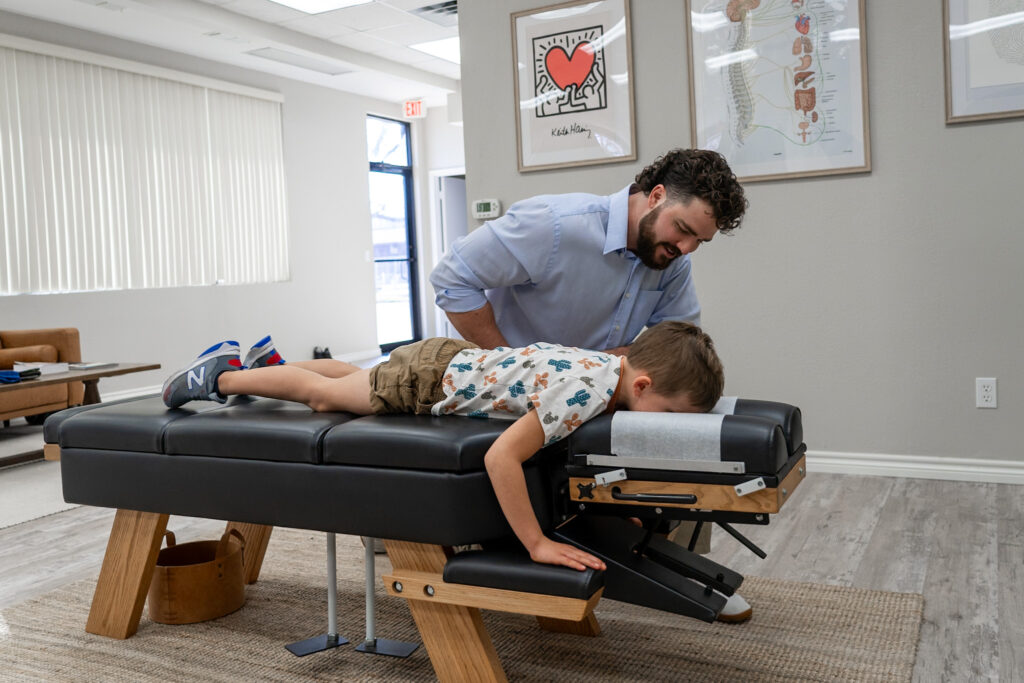
Dr. Korrin assesses all six zones at every infant visit and adjusts at the levels where interference is found. For a young infant, the adjustment uses gentle fingertip pressure at the relevant upper cervical level. There is no manipulation, no twisting, no force. The contact is lighter than what you would use to test the ripeness of fruit. Most infants tolerate the assessment without distress. Some become noticeably calmer during the session. Parents frequently report that their baby feeds more comfortably and arches less within the first week or two of care as the vagal regulation pattern begins to shift.
What to Expect at Your Baby’s First Visit
Your baby’s first visit begins with a Zone Technique assessment of the full nervous system. Dr. Korrin evaluates all six zones and identifies where interference is present, with particular focus on the upper cervical and digestive zone levels most relevant to reflux. The assessment takes 15 to 20 minutes. He will ask about your baby’s birth history, how long the reflux has been present, whether medication has been prescribed and how well it is working, the feeding pattern including how your baby positions during and after feeds, and whether there is also a colic or crying pattern present alongside the reflux.
Feed your baby before the visit if possible. You will be present for the entire assessment and adjustment. Bring any pediatric notes or feeding evaluation results you have. If your baby has been seen by a lactation consultant or feeding therapist alongside the reflux diagnosis, that information helps Dr. Korrin understand the full feeding picture before the Zone Technique assessment begins.
Reflux and colic frequently coexist in infants because both involve the digestive zone and the vagus nerve pathway. Many infants at Vita Nova present with both simultaneously and the Zone Technique assessment identifies both zone patterns in the same visit. If your baby also has difficulty latching or shows signs of a feeding difficulty beyond the reflux, the infant chiropractic care page covers how Zone Technique approaches broader infant feeding presentations. For infants whose reflux is accompanied by significant gas, bloating, or irregular stooling, pediatric constipation may also be part of the digestive picture worth evaluating.
Dr. Korrin sees infant reflux patients from across Plano, Murphy, and Richardson at Vita Nova. Families come in after the standard reflux pathway, positioning changes and medication, has not fully resolved the discomfort and arching that makes feeding difficult for their baby. Dr. Korrin is accepting new pediatric patients. Schedule your baby’s first visit to find out whether the nervous system component of your baby’s reflux is something Zone Technique can address.