

Your child is pulling at their ear, tilting their head, or telling you their ear hurts. It may be a confirmed ear infection. It may be pain between infections that has not fully resolved. It may be a pressure or fullness that the pediatrician cannot find a clear cause for. Ear pain in children is almost always a drainage and immune system pattern, and that pattern has a nervous system component that Zone Technique is built to assess.
What Could Be Causing Your Child’s Ear Pain?
Ear pain in children most commonly involves the middle ear, where fluid accumulation, infection, or pressure changes produce pain that ranges from dull aching to sharp and intense. The Eustachian tube, which drains the middle ear and equalizes pressure, runs at a shallower angle in young children than in adults, making drainage less efficient and fluid accumulation more common. When the upper cervical spine is under mechanical stress, the cervical sympathetic chain adjacent to C1 and C2 affects Eustachian tube muscle tone and drainage efficiency. Middle ear fluid accumulates more readily, pressure builds, and the child experiences the ear pain and pressure that frequently brings families to the practice.
Ear pain between confirmed infection episodes is the presentation that most clearly benefits from Zone Technique assessment. Active bacterial ear infections with fever need appropriate medical treatment first. The ear pain that persists after an infection has cleared, or that recurs at a lower level between episodes, reflects the drainage pattern that Zone Technique addresses directly. The ear infections chiropractic care page covers the recurrent infection pattern in detail.
How Dr. Korrin Approaches Ear Pain Using Zone Technique
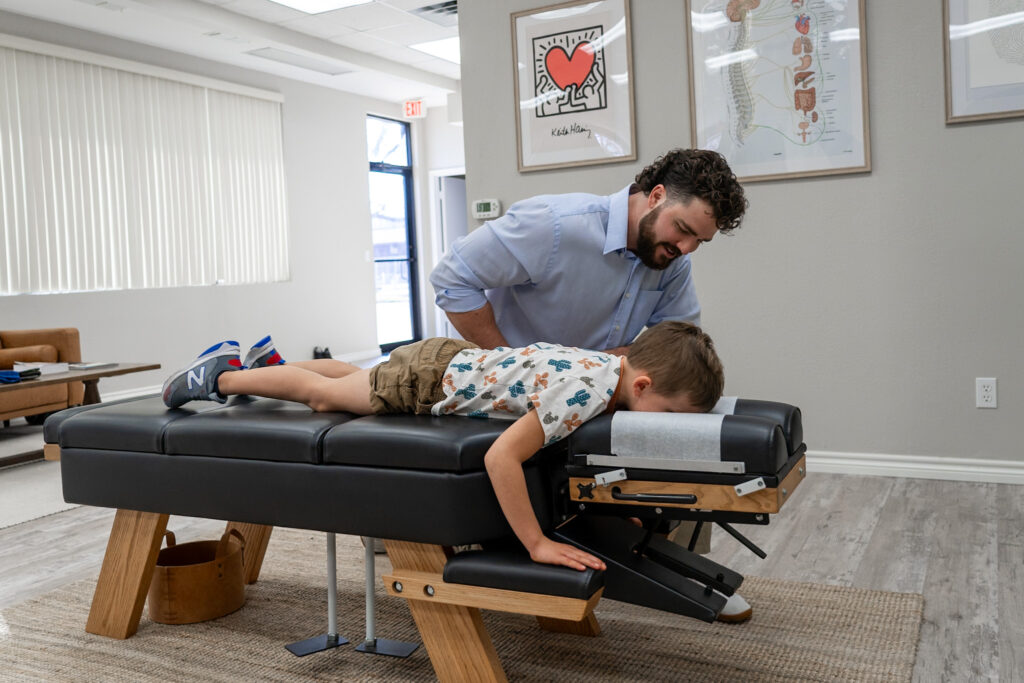
For ear pain presentations, Zone Technique focuses on two zones. The glandular zone(1) governs immune function and lymphatic drainage. Zone 1 interference at the upper cervical levels affects how efficiently the immune system clears middle ear fluid and reduces inflammation between infection episodes. The nervous zone(3) governs the cervical sympathetic chain and the nerve pathways that control Eustachian tube muscle tone. Zone 3 interference at C1 and C2 maintains elevated sympathetic tone in the Eustachian tube musculature, reducing drainage efficiency and allowing fluid and pressure to persist. Dr. Korrin adjusts at the specific upper cervical levels where Zone 1 and Zone 3 interference is found. The adjustment for a toddler or young child uses gentle fingertip pressure adapted for their size and age.
What to Expect at Your Child’s First Visit
Your child’s first visit begins with a Zone Technique assessment of the full nervous system. Dr. Korrin evaluates all six zones and identifies where interference is present, with particular focus on the upper cervical and immune zone levels most relevant to ear pain. The assessment takes 15 to 20 minutes. He will ask how long the ear pain has been present, whether a current infection has been confirmed, how many ear infections your child has had, and whether there is associated hearing difficulty or speech delay. If your child has been seen by a pediatrician or ENT for the ear pain, bring any notes or findings from that evaluation.
If your child’s ear pain is part of a recurrent infection pattern, the ear infections chiropractic care page covers the drainage and immune mechanism in detail and explains how Zone Technique addresses the pattern between infections rather than the acute episode. If ear pain is accompanied by dizziness or balance difficulties, the vertigo chiropractic care page covers how the upper cervical spine and vestibular system interact. The pediatric chiropractic care page covers the full scope of what Dr. Korrin does for children at Vita Nova.
Dr. Korrin sees ear pain presentations from across Plano, Murphy, and Richardson at Vita Nova. He is accepting new pediatric patients. Schedule your child’s first visit to find out whether the drainage and immune pattern driving the ear pain has a nervous system component that Zone Technique can address.