Saturday was supposed to be different. Park with the kids, maybe a run before the North Texas heat made that impossible. By 7:30am the pressure was already building behind your left eye. You knew what that meant. You closed the curtains, reached for the medication on the nightstand, and did the calculation you’ve done a hundred times: how much of the day you could still save.
That’s not pain management. That’s life management: planning your week around a condition you’ve come to accept as permanent.
What Is a Migraine?
A migraine isn’t just a severe headache. It’s a neurological event driven by the trigeminovascular system, the network of nerves and blood vessels that regulate pain sensation across the head and face. During an attack, this system misfires: blood vessels around the brain dilate abnormally, sensory nerves fire along the trigeminal pain pathway, and the result is the throbbing pain, light and sound sensitivity, nausea, and cognitive fog that most migraine patients recognize immediately.
Three distinct physiological systems typically feed that misfire. Hormonal fluctuations, particularly drops in estrogen, prime the nervous system for attack. Structural tension or misalignment in the upper cervical spine irritates nerve roots that share pain pathways with the trigeminal nerve. And disruptions in cerebrovascular blood flow regulation drive the vascular throbbing phase. Addressing only one of the three is the most common reason patients get partial relief but not a meaningful reduction in frequency.
If you experience frequent headaches that don’t follow the migraine pattern, our
headaches chiropractic care page covers that presentation separately.
Migraines affect women at roughly three times the rate of men, with peak incidence during the reproductive years when hormonal cycling is most active. A significant share of Dr. Korrin’s migraine patients are working women in their 30s and 40s, where deadline pressure, screen hours, and disrupted sleep are occupational constants. Hormonal migraines during pregnancy are also common: estrogen levels shift rapidly, medication options narrow sharply, and the neurological threshold for attacks drops. The
pregnancy chiropractic care page covers how Zone Technique approaches migraines in that context specifically.
How Dr. Korrin Treats Migraines Using Zone Technique
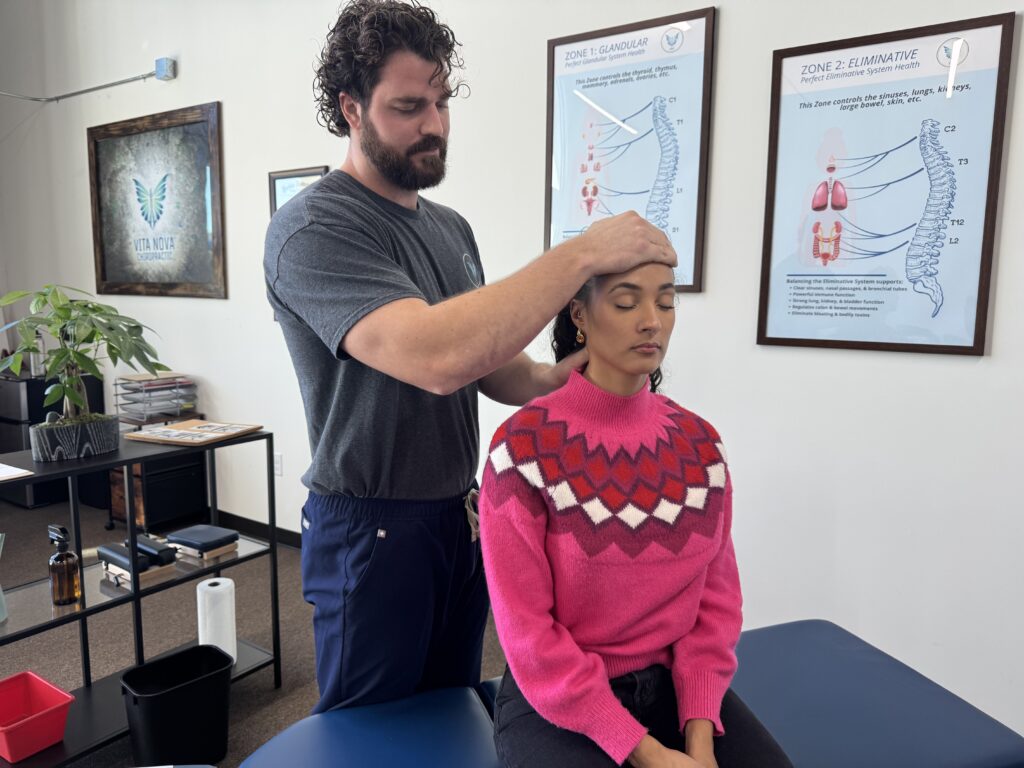
Zone Technique evaluates the nervous system through six body zones. For migraine patients, three zones address the distinct mechanisms that drive a migraine attack. Most patients present with more than one zone active simultaneously, which is why single-focus approaches produce partial results.
Zone 1, the glandular zone, addresses hormonal migraine triggers. Estrogen fluctuation is one of the most documented migraine drivers: the premenstrual drop in estrogen, postpartum hormone shifts, and perimenopause are all periods of elevated migraine frequency. Zone 1 assessment maps the spinal levels governing glandular system communication and restores the nervous system signaling that supports hormonal regulation. This is the component of migraine physiology that most medication protocols don’t target directly.
Zone 3, the nervous zone, addresses the cervicogenic component. The upper cervical spine at C1 through C3 sits directly adjacent to nerve roots that share pain pathways with the trigeminal nerve. Misalignment or chronic muscular tension at those levels sends referred pain signals toward the head along the trigeminal pathway. Patients with this pattern typically notice neck stiffness or tightness at the base of the skull in the hours before a migraine begins. Dr. Korrin’s Zone 3 adjustments reduce that structural irritation at its source, not at the location where the pain arrives.
Zone 6, the circulatory zone, addresses the vascular phase. The throbbing quality most patients associate with migraines reflects vasomotor dysregulation: blood vessels in and around the brain constricting and dilating abnormally. Zone Technique assessment identifies spinal levels where nervous system interference is disrupting blood flow regulation to the head and addresses that interference directly.
Dr. Korrin evaluates all three zones at every visit as part of a coordinated
headache and migraine chiropractic care plan. When
nervous system dysfunction is contributing to the migraine pattern, Zone Technique evaluates that within the same assessment rather than as a separate concern.
What to Expect at Your First Visit
Your first appointment starts with a full Zone Technique assessment across all six zones, not just the headache location. For migraine patients, Dr. Korrin specifically evaluates how Zone 1, Zone 3, and Zone 6 are interacting, because each zone can prime or amplify the others. This takes 15 to 20 minutes. Dr. Korrin covers migraine frequency, trigger pattern, cycle timing if relevant, and prior treatments before completing the full Zone Technique spinal evaluation.
By the end of the visit you’ll know which zones are active, what the most likely contributors to your migraine pattern are, and what care frequency fits your presentation. Most migraine patients start at two visits per week, tapering as frequency and severity decrease. If your migraines have a clear hormonal component, you’ll leave with specific guidance for the high-risk days in your cycle. That’s when Zone 1 glandular activity is most likely to spike.
Most of Dr. Korrin’s migraine patients in
Plano, TX fall into two groups. The first: working women whose migraines arrive mid-week, once deadline pressure and sleep deprivation have been stacking for days. The second: active adults who managed the whole week intact, then lost their Saturday morning to a migraine the moment they stopped moving. Both patterns respond to Zone Technique care. Both had assumed medication was their only option.
What Patients Experience
Many patients who come to Dr. Korrin for migraines have been managing with prescription medication for years. Not because it stopped working, but because they’d accepted migraines as a condition to manage rather than one with an addressable cause. The shift often begins with a question no prior provider had asked: whether the neck stiffness that arrives the afternoon before a migraine is cause or coincidence.
One patient, a woman in her early 40s, had tracked two to three migraines a month for several years. She came in after a stretch of many migraines. Zone Technique assessment showed active Zone 1 glandular and Zone 3 nervous zones: her hormonal cycle timing and upper cervical tension were both contributing to her pattern. After several weeks of Zone Technique care, her migraine frequency dropped significantly. What changed wasn’t that medication stopped working. It was that she needed it less often.
Zone Technique reaches what medication management doesn’t: the pattern underneath the migraine, not just the event after it arrives. For patients who’ve managed symptoms for years without a reduction in frequency, that difference is significant.
When Should You See a Chiropractor for Migraines?
The most common reason migraine patients wait too long is a belief that nothing beyond medication is available. That assumption is worth questioning directly.
Seek an evaluation if migraines occur more than twice a month, if medication is losing effectiveness over time, or if your migraines consistently begin with neck stiffness before the head pain arrives. Each of those patterns indicates a treatable structural or hormonal contributor, not an untreatable neurological condition. Patients who’ve added a second medication to manage the first are a clear candidate for a root-cause evaluation.
If migraines come with significant dizziness or
vertigo, Zone Technique addresses those presentations through Zone 3 and Zone 6 in the same assessment. Patients whose migraines begin with
neck pain in the hours before head pain arrives are often the clearest candidates for Zone 3 cervicogenic care. The cervicogenic pattern responds quickly and reliably relative to other migraine types.
Supporting Your Recovery Between Visits
Three at-home habits consistently reduce migraine frequency between Zone Technique visits.
Hydration is the most controllable trigger most patients underestimate. Consistent fluid intake across the day, rather than catching up in the evening, reduces the frequency of dehydration-triggered attacks. Most migraine patients are significantly under-hydrated during work hours without knowing it.
Sleep consistency matters more than total sleep time. Keeping a fixed wake time even on weekends prevents the cortisol rhythm disruptions that produce the Saturday-morning migraine pattern many Plano patients describe.
Difficulty sleeping and migraine frequency are tightly linked. Improving sleep quality is one of the most effective between-visit changes you can make.
Screen and neck position: a monitor at eye level rather than angled downward reduces the chronic tension accumulation in C1-C3 where cervicogenic migraines originate. Over a workday, even a 10-degree downward angle changes how much upper cervical load you carry. Chronic
stress is a Zone 1 glandular trigger. Brief walking breaks during the workday interrupt the cortisol patterns that prime hormonal attacks, and the effect compounds across a week.
Have more questions about migraines and chiropractic care? The
Migraine FAQ is where Dr. Korrin answers the ones patients ask most.
Dr. Korrin is accepting new patients at Vita Nova Chiropractic in Plano, TX.
Schedule your first visit and find out what’s driving your migraines.