
The numbness and tingling in your hand wakes you at night. It is worse when you hold your phone, type for extended periods, or drive with your wrists bent. Your doctor has confirmed carpal tunnel syndrome and recommended a brace, anti-inflammatories, or surgery. Before committing to any of those options it is worth understanding whether the symptoms are originating in the wrist alone, or whether a cervical nerve root is contributing to the picture, because the assessment and the approach differ significantly between the two.
What Is Carpal Tunnel Syndrome?
Carpal tunnel syndrome (CTS) occurs when the median nerve is compressed as it passes through the carpal tunnel, the narrow passageway in the wrist formed by the carpal bones and the transverse carpal ligament. Compression produces the characteristic numbness, tingling, and pain in the thumb, index finger, middle finger, and the radial half of the ring finger that the median nerve supplies. In severe cases, weakness of the thenar muscles at the base of the thumb develops.
What is frequently overlooked is the double crush phenomenon. A nerve that is compressed or irritated at a proximal location, such as the C6 nerve root in the cervical spine, is more susceptible to compression at a distal location like the carpal tunnel. A systematic review in Plastic and Reconstructive Surgery found that cervical radiculopathy and carpal tunnel syndrome co-occur at rates significantly higher than chance, supporting the double crush mechanism as a clinically significant consideration. Patients who have had carpal tunnel surgery without full resolution of symptoms, or who have symptoms that do not fully match the classic CTS distribution, frequently have a cervical component that was not identified or addressed.
Who Develops Carpal Tunnel Syndrome
CTS is the most common mononeuropathy in adults and is strongly associated with repetitive wrist flexion and extension, sustained keyboard and mouse use, and vibration exposure. Desk workers with years of sustained typing, assembly workers, construction tradespeople, and anyone with prolonged wrist loading are the most common presentations. Women are twice as likely as men to develop CTS, with hormonal factors, pregnancy-related fluid retention, and anatomical differences in carpal tunnel dimensions all contributing. At Vita Nova, the most common CTS presentation is the desk worker or remote professional from the West Plano corporate corridor whose cervical spine is carrying years of sustained forward head posture load alongside the wrist-level compression.
How Dr. Korrin Approaches Carpal Tunnel Syndrome Using Zone Technique
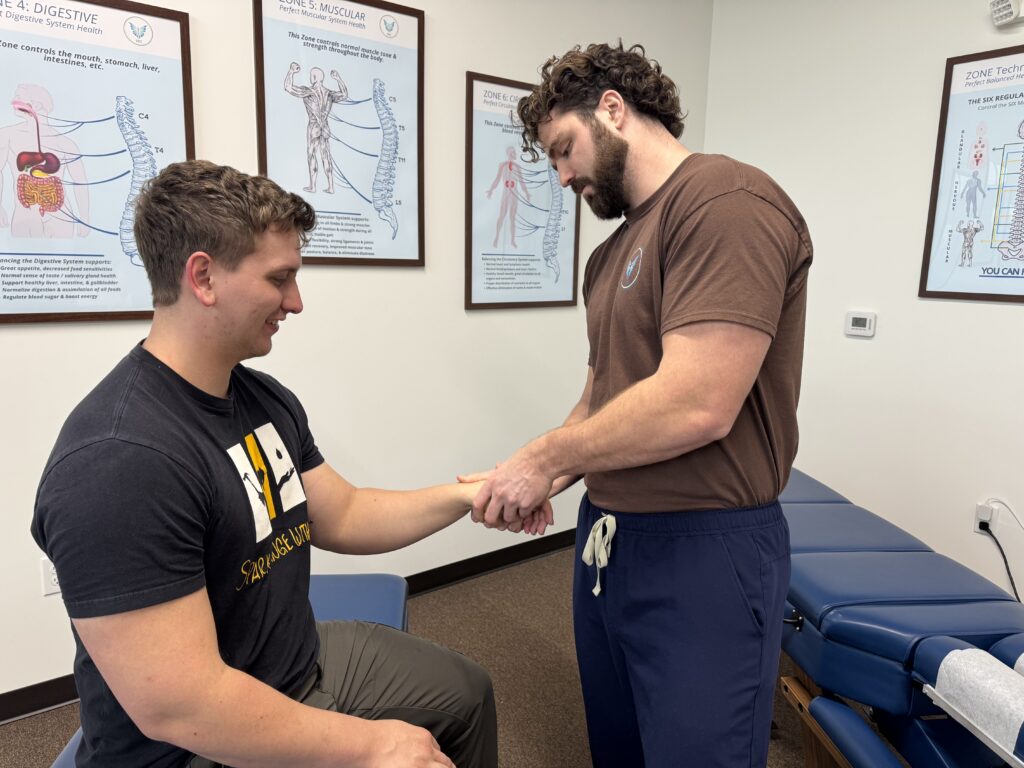
For carpal tunnel syndrome, Zone Technique assesses whether nervous system interference at the cervical levels governing the median nerve distribution is contributing to the symptoms alongside or instead of the wrist-level compression. The nervous zone(3) at the C6 and C7 cervical levels governs the nerve roots that form the median nerve. When Zone 3 is under interference at those levels, the median nerve is already compromised proximally before it reaches the carpal tunnel. Addressing that cervical interference reduces the overall nerve sensitization and frequently improves the hand symptoms even when the carpal tunnel compression itself has not changed. The muscular zone(5) tracks the forearm and wrist flexor tension pattern that compresses the carpal tunnel from the muscular side. Zone 5 interference maintains the sustained forearm muscle contraction that narrows the carpal tunnel independent of wrist position. Dr. Korrin assesses both zones at every visit and adjusts at the levels where interference is found.
What to Expect at Your First Visit
Your first visit begins with a Zone Technique assessment of the full nervous system. Dr. Korrin evaluates all six zones and identifies where interference is present across both the cervical spine and the wrist-level anatomy. The assessment takes 15 to 20 minutes. He will ask which fingers are affected, whether symptoms are bilateral or one-sided, what time of day they are worst, whether neck pain or upper arm symptoms accompany the hand symptoms, and what your work and daily activity demands look like. If you have had nerve conduction studies or EMG results, bring them. The neurophysiological picture from prior testing helps Dr. Korrin understand the severity of the median nerve involvement and how the Zone Technique findings map to it.
For hand and wrist symptoms where the source is higher up the chain, cervical nerve root compression produces an identical distribution to carpal tunnel and is frequently the missed component in CTS that did not fully resolve with wrist treatment. When the arm symptoms are broader than just the hand, Zone Technique maps the full arm pain pattern back to the specific cervical level of origin. And for patients whose hand numbness and tingling persists at rest without a clear positional trigger, peripheral neuropathy involves a different mechanism and a different Zone Technique approach than mechanical nerve compression.
Dr. Korrin is accepting new patients at Vita Nova in Plano, TX. Schedule your first visit to find out whether the cervical component of your carpal tunnel symptoms is something Zone Technique can address before considering other interventions.