
You can fall asleep but you cannot stay asleep. Or you cannot fall asleep at all despite being exhausted. Or you sleep eight hours and wake up unrested. Sleep difficulty that persists beyond obvious causes, too much caffeine, poor sleep hygiene, significant stress, almost always involves a nervous system that cannot make the shift into the parasympathetic state that restorative sleep requires. That shift is governed by the vagus nerve, and the vagus nerve runs through the upper cervical spine.
Sleep Difficulty and the Nervous System
Sleep is a parasympathetic state. The transition from wakefulness into sleep requires the autonomic nervous system to shift from sympathetic dominance into parasympathetic dominance. Heart rate slows, cortisol drops, digestive activity quiets, and the brain cycles into the restorative phases that consolidate memory, clear metabolic waste, and restore cellular energy. When the vagus nerve cannot fully engage the parasympathetic system, that transition is impaired. The person lies awake with a mind that will not stop, or wakes repeatedly as the nervous system slides back toward sympathetic activation before completing the restorative cycle.
Research published in Frontiers in Neuroscience confirmed that vagal tone is a key determinant of sleep quality and parasympathetic nervous system function, with lower vagal tone consistently associated with sleep disruption, reduced slow-wave sleep, and impaired overnight physiological recovery. The vagus nerve runs from the brainstem through the upper cervical spine at C1 and C2. Mechanical interference at those levels reduces vagal tone directly, and that reduced tone makes the shift into restorative sleep harder to achieve and maintain.
How Dr. Korrin Approaches Sleep Difficulty Using Zone Technique
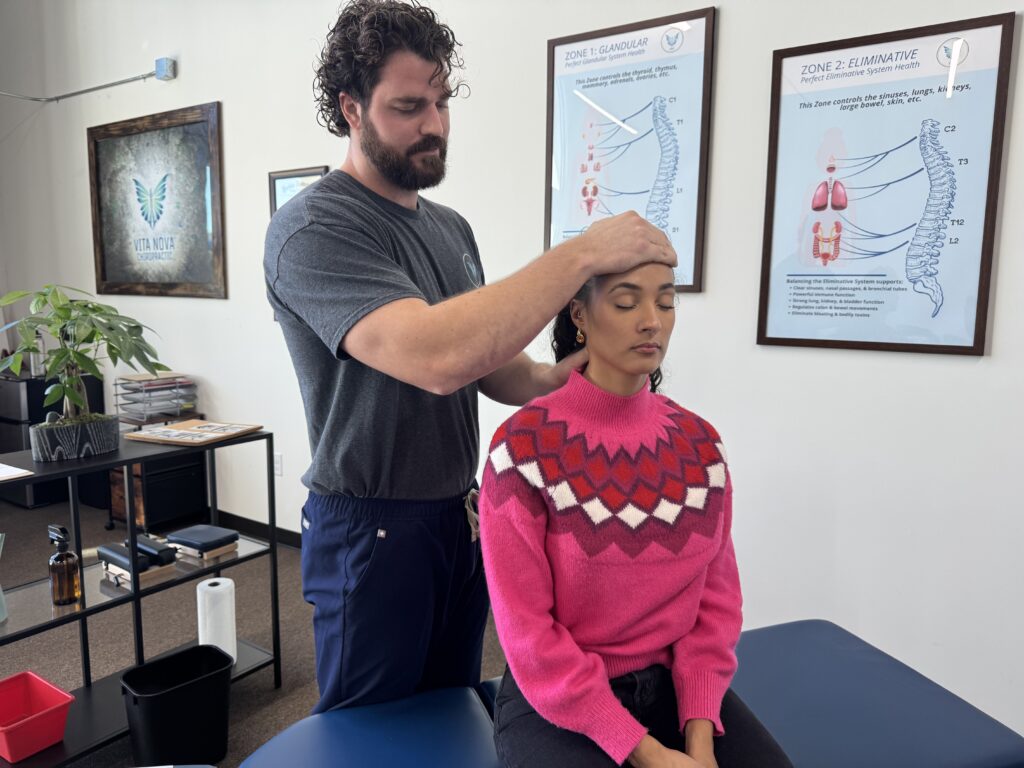
For sleep difficulty, Zone Technique targets the nervous zone(3) at the upper cervical levels governing vagal tone and parasympathetic nervous system engagement. When Zone 3 is under interference at C1 and C2, the vagus nerve cannot fully drive the parasympathetic shift that sleep onset requires. The glandular zone(1) is assessed alongside Zone 3 for patients whose sleep difficulty has a cortisol component, specifically those who wake between 2 and 4am when cortisol naturally begins rising and whose nervous system cannot suppress that rise adequately. Dr. Korrin adjusts at the specific levels where interference is found at every visit, and tracks sleep quality as a primary indicator of how the Zone 3 interference pattern is responding to care.
Your first visit begins with a Zone Technique assessment of the full nervous system. The assessment takes 15 to 20 minutes. Dr. Korrin will ask about the sleep pattern specifically, what the difficulty looks like, how long it has been present, what you have tried, and whether there are other nervous system symptoms alongside the sleep difficulty. Sleep difficulty that accompanies anxiety or fibromyalgia reflects the same autonomic dysregulation pattern across all three and Zone Technique addresses the shared mechanism in the same assessment. Dr. Korrin is accepting new patients at Vita Nova in Plano, TX. Schedule your first visit to find out whether nervous system interference is what is preventing your sleep from being restorative.