
The elbow hurts but the elbow may not be the source. Lateral elbow pain that is diagnosed as tennis elbow, medial elbow pain diagnosed as golfer’s elbow, and elbow pain with associated forearm or hand tingling all have a cervical nerve root component that is frequently missed when the evaluation focuses on the elbow alone. Zone Technique identifies whether the pain is originating locally in the elbow joint and surrounding tendons, in the cervical nerve root supply to the elbow region, or in both simultaneously.
What Could Be Causing Your Elbow Pain?
Elbow pain in adults falls into several distinct patterns. Lateral epicondylalgia, commonly called tennis elbow, involves the common extensor tendon origin at the lateral epicondyle and is associated with repetitive wrist extension and gripping activities. Medial epicondylalgia involves the flexor-pronator tendon origin at the medial epicondyle and is more common in throwing athletes and manual workers. Both are genuinely local tendinopathies in most presentations, but both are also in the distribution of the C6 and C7 nerve roots, which supply the lateral forearm and elbow and whose irritation from cervical disc or facet pathology produces pain in the same location as the local tendinopathy.
The distinction matters because the treatment approach differs. Local tendinopathy responds to load management, progressive tendon loading, and addressing the muscular activation patterns driving the overload. Cervical nerve root involvement responds to Zone Technique adjustment at the relevant cervical levels. When both are present, which is common in the desk worker whose cervical spine is under sustained flexion load from years of screen time and who develops lateral elbow pain from the same keyboard and mouse use, addressing only one produces partial results. Zone Technique assesses both in the same evaluation.
How Dr. Korrin Approaches Elbow Pain Using Zone Technique
For elbow pain, Zone Technique assesses the nervous zone(3) at the C6 and C7 cervical levels governing the nerve supply to the lateral and medial elbow. When Zone 3 shows interference at those levels, the nerve roots supplying the elbow are sensitized proximally, which amplifies the pain signal from any local tendon pathology at the elbow itself and makes recovery from the tendinopathy slower. The muscular zone(5) tracks the forearm extensor and flexor muscle tension pattern that overloads the tendon attachments. When Zone 5 is under interference at the cervical and thoracic levels governing forearm muscle activation, the muscles remain in a state of chronic tension that maintains the load on the epicondyle regardless of how much the patient rests the arm.
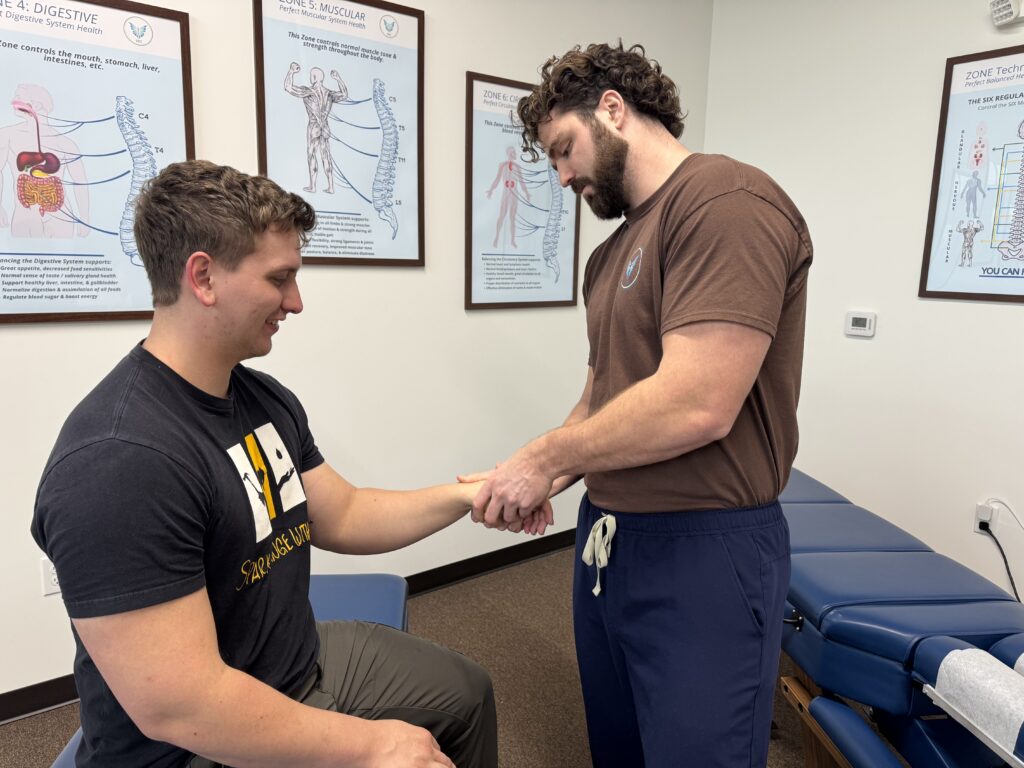
Your first visit begins with a Zone Technique assessment of the full nervous system. Dr. Korrin evaluates all six zones and identifies where interference is present, with particular focus on the cervical levels most relevant to the elbow pain distribution. The assessment takes 15 to 20 minutes. He will ask about the pain location, whether it is lateral or medial, what activities provoke it, whether there is any tingling or numbness in the forearm or hand, and what your work and recreational demands look like. If there is a cervical component, the full arm pain pattern from a cervical source is worth evaluating alongside the elbow presentation. For elbow pain with associated wrist and hand symptoms, the double crush mechanism linking cervical nerve root involvement to distal compression is covered in detail on the carpal tunnel page. Dr. Korrin is accepting new patients at Vita Nova in Plano, TX. Schedule your first visit to find out where the elbow pain is actually coming from.