
You are managing it. You have the routines, the exercise, the sleep hygiene. You know what the stress is coming from. What you cannot seem to change is the baseline. The nervous system that is always slightly activated, that does not fully settle even when nothing is actively wrong, that turns ordinary pressures into a physical tension response you carry in your shoulders, your jaw, and your sleep. That baseline is a nervous system regulation problem, and it responds to Zone Technique in a way that stress management strategies alone do not reach.
Stress as a Nervous System Problem
Stress is a physiological state, not just a psychological one. The HPA axis, the hypothalamic-pituitary-adrenal system, governs the cortisol and adrenaline response to perceived threats. In acute stress it activates, produces the fight-or-flight response, and then recovers. In chronic stress that recovery is incomplete. The nervous system stays in a mildly activated state between stressors, the cortisol baseline remains elevated, and the parasympathetic rest-and-digest system cannot fully engage.
The physical consequences of sustained HPA axis activation are well documented. Impaired immune function, disrupted sleep architecture, elevated cardiovascular risk, digestive disruption, and musculoskeletal tension that becomes structural over time. Research published in Annals of the New York Academy of Sciences has established that the autonomic nervous system and HPA axis interact bidirectionally, and that chronic sympathetic activation produces sustained changes in cortisol regulation that outlast the original stressor. The upper cervical spine is the mechanical gateway of the autonomic nervous system. When C1 and C2 are under mechanical interference, the brainstem cannot modulate the sympathetic-parasympathetic balance efficiently. The chronic stress state persists not only because of the stressors in the environment but because the nervous system has lost the mechanical ability to return to baseline.
A 2021 systematic review in Frontiers in Neuroscience found that vagal tone is a consistent predictor of stress resilience and HPA axis recovery, with higher vagal tone associated with faster cortisol recovery after stress exposure. The vagus nerve, which is the primary driver of vagal tone, runs from the brainstem through the upper cervical spine at C1 and C2 before branching into the chest and abdomen. Mechanical interference at those levels directly reduces vagal tone. Restoring that tone through Zone Technique adjustment is the mechanism by which chiropractic care addresses the chronic stress baseline rather than just its surface expressions.
Who Develops a Chronic Stress Baseline
The presentation Dr. Korrin sees most often at Vita Nova is the high-functioning adult who is managing stress well by all external measures but whose nervous system cannot fully recover between demands. The corporate professional from the Legacy Drive corridor or the tollway office parks in West Plano who is performing well, exercising, getting adequate sleep, and still carrying a background tension that does not resolve on its own. The parent managing a demanding job alongside young children whose nervous system has been in sustained activation for months or years. The individual who has been through a significant stressor, a job change, a move, a health scare, a relationship shift, and whose stress response is still firing at the level it established during that period even though the acute stressor has passed.
All of these presentations share the same nervous system feature: a sympathetic tone that is chronically elevated and a parasympathetic system that cannot fully engage to bring it back to baseline. Zone Technique finds where the mechanical interference is maintaining that pattern and addresses it directly.
How Dr. Korrin Approaches Stress Using Zone Technique
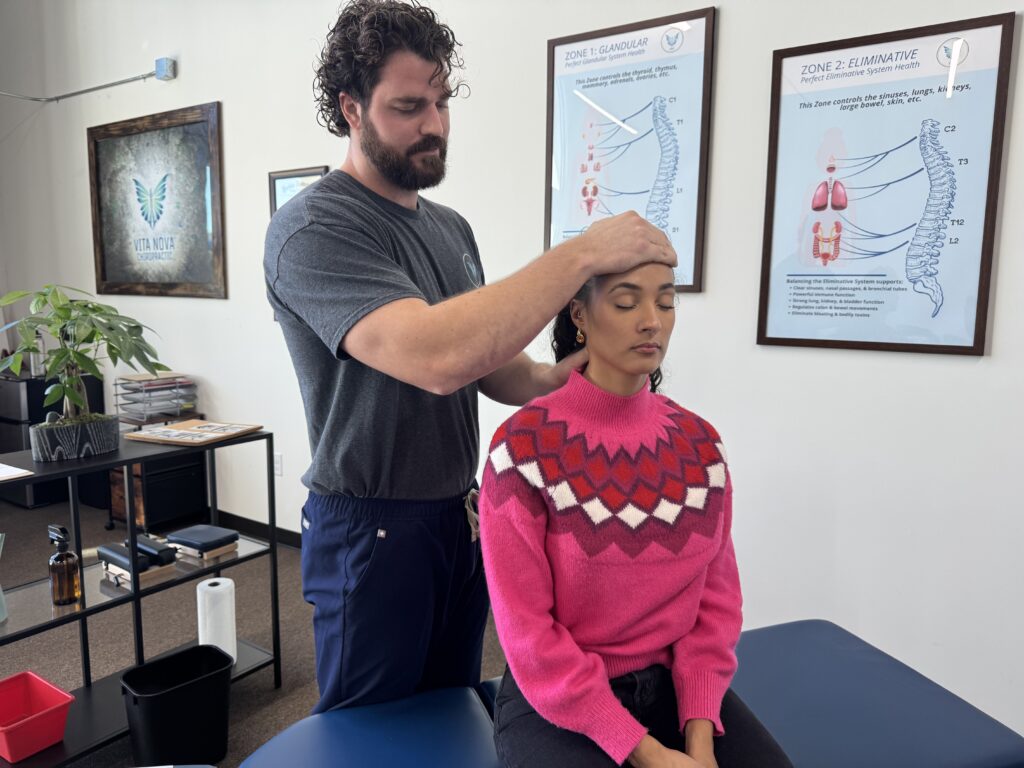
For chronic stress, Zone Technique targets the glandular zone(1) and the nervous zone(3) simultaneously. Zone 1 governs the HPA axis and the cortisol regulation that determines the stress response baseline. When Zone 1 is under interference, the hormonal calibration of the stress response becomes less precise. The threshold for activation lowers, the recovery from activation takes longer, and the sustained cortisol elevation that results produces the physical and cognitive symptoms of chronic stress. Zone 3 governs the upper cervical nerve pathways and the vagus nerve, which is the primary regulator of parasympathetic nervous system function. When Zone 3 is under interference at C1 and C2, vagal tone is reduced and the nervous system cannot shift efficiently into the parasympathetic state that allows stress recovery.
The Zone Technique adjustment at the specific levels where Zone 1 and Zone 3 interference is found works to restore clearer vagal regulation and more effective HPA axis modulation. Dr. Korrin assesses all six zones at every visit and tracks changes in the interference pattern over the course of care. Most patients notice the change in sleep quality first as the parasympathetic system recovers enough to produce more restorative sleep. Then in the background tension they carry through the day. Then in the activation threshold itself. The things that used to tip them into a stress response begin requiring a meaningfully larger trigger.
What to Expect at Your First Visit
Your first visit begins with a Zone Technique assessment of the full nervous system. Dr. Korrin evaluates all six zones and identifies where interference is present, with particular focus on the glandular and nervous zones most relevant to stress regulation. The assessment takes 15 to 20 minutes. He will ask about the stress pattern, when the baseline elevated, what your sleep quality looks like, and whether you carry tension in specific physical locations, the neck, jaw, shoulders, or gut, that are consistent between stress episodes. That physical signature helps identify which zones are most involved and where the Zone Technique assessment should focus.
Supporting the Nervous System Between Visits
Zone Technique addresses the mechanical interference that keeps the stress response elevated. What you do between visits determines how effectively the nervous system uses the window the adjustment creates. The most impactful change for chronic stress patients is protecting the parasympathetic window in the evening, roughly two hours before sleep, from the inputs that re-engage the sympathetic system: screen use, difficult conversations, high-stimulus environments. The adjustment gives the nervous system the capacity to shift into parasympathetic activation. The evening environment determines whether it does. Brief slow nasal breathing practices of five to ten minutes, specifically the extended exhale pattern where the exhale is longer than the inhale, are the most evidence-supported tool for directly increasing vagal tone between visits and extending the parasympathetic recovery that Zone Technique initiates.
Chronic stress is one of the most consistent adult presentations at Vita Nova: high external load, adequate coping strategies, and a nervous system that cannot fully recover between demands because the mechanical regulation that would allow it to is under interference. Dr. Korrin is accepting new patients at Vita Nova in Plano, TX. Schedule your first visit to find out whether nervous system interference is contributing to your stress baseline.