
The bursa is inflamed and the joint is painful. Anti-inflammatories help temporarily. A cortisone injection provided relief for a few weeks before the pain returned. Bursitis that keeps coming back is almost always being maintained by a mechanical pattern that neither anti-inflammatories nor injections address. That pattern is what Zone Technique assesses.
What Is Bursitis?
Bursae are small fluid-filled sacs that cushion the bones, tendons, and muscles near joints. Bursitis occurs when a bursa becomes inflamed, typically from repetitive movement, prolonged pressure, or altered joint mechanics that create abnormal friction at the bursa. The most common locations are the hip (trochanteric bursitis), shoulder (subacromial bursitis), elbow (olecranon bursitis), and knee (prepatellar bursitis). Each of these locations receives nerve supply from specific spinal levels, and when those levels are under nervous system interference, the surrounding musculature develops altered activation patterns that change the joint mechanics and increase bursal friction.
Recurrent bursitis is the pattern that points most clearly toward a nervous system and mechanical component. A single acute bursitis from a fall or direct impact is a local inflammatory event. Bursitis that returns repeatedly at the same location despite appropriate treatment is being driven by the altered joint mechanics and muscular tension patterns that create ongoing friction at the bursa. Those patterns originate in the nervous system.
How Dr. Korrin Approaches Bursitis Using Zone Technique
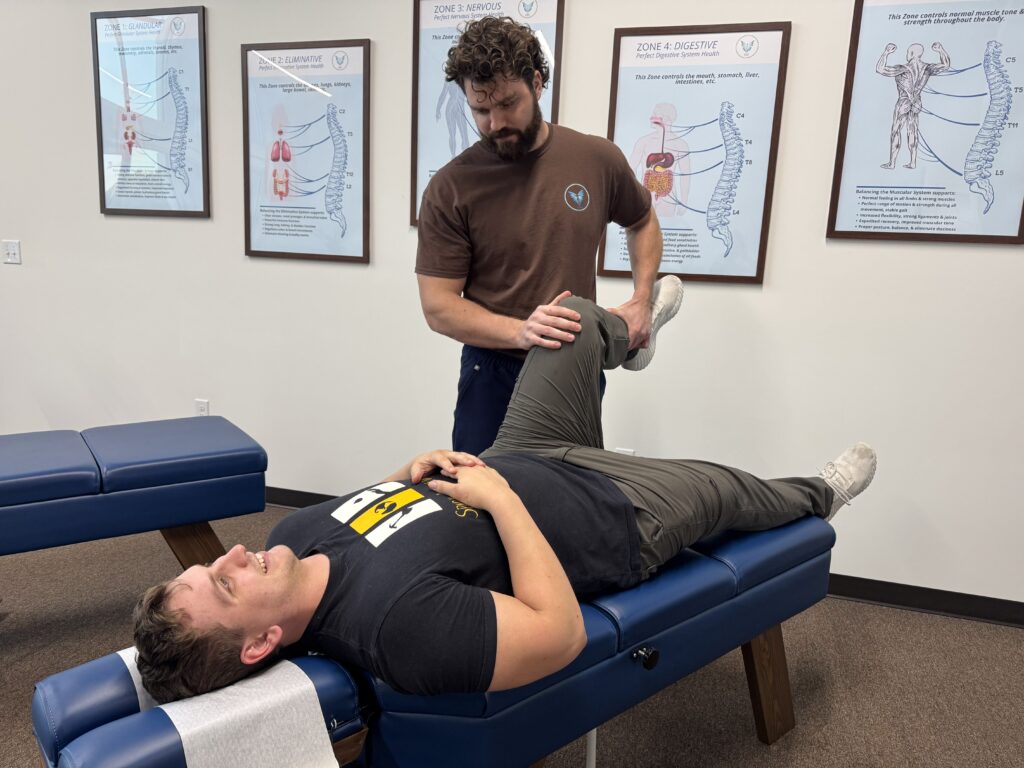
For bursitis, Zone Technique assesses the muscular zone(5) for the altered activation pattern in the muscles surrounding the affected joint. When Zone 5 is under interference at the spinal levels governing those muscles, they develop chronic tension asymmetries that alter joint mechanics and produce ongoing bursal friction. The nervous zone(3) governs the nerve root supply to the joint region, and when Zone 3 shows interference at the relevant spinal level, the nerve signals coordinating the surrounding musculature are disrupted at their origin. Dr. Korrin adjusts at the specific levels where interference is found rather than treating the inflamed bursa directly.
Your first visit begins with a Zone Technique assessment of the full nervous system. Dr. Korrin will ask about which joint is affected, how long the bursitis has been recurring, what treatment has been tried, and whether there is any associated neck or back pain that might indicate a spinal source for the joint mechanics problem. For hip bursitis specifically, the lumbar and SI joint components that alter hip mechanics are worth assessing alongside the local bursal presentation. For shoulder bursitis, the cervical nerve root component that affects shoulder muscle activation is frequently involved. Dr. Korrin is accepting new patients at Vita Nova in Plano, TX. Schedule your first visit to find out whether the mechanical pattern maintaining your bursitis has a nervous system source Zone Technique can address.