
The accident itself was minor. Low speed, minimal damage, maybe a tow. You felt fine immediately after and told the officer as much. By the next morning your neck was stiff. By day three you could not turn your head without pain. Two weeks later the stiffness has not fully resolved and you are starting to get headaches you did not have before. This is the typical whiplash timeline, and the gap between the accident and the onset of symptoms is the reason most people underestimate how significant the injury actually is.
What Is Whiplash?
Whiplash is a soft tissue injury to the cervical spine caused by rapid acceleration-deceleration of the head. In a rear-end collision, the head snaps backward into hyperextension and then forward into hyperflexion faster than the surrounding musculature can respond. The result is a stretch injury to the cervical ligaments, muscles, and joint capsules that stabilize the neck. In more significant impacts, disc involvement and nerve root irritation are also part of the picture.
The clinical term is whiplash-associated disorder, or WAD, and it exists on a spectrum. Grade 1 involves neck pain and stiffness with no physical signs on exam. Grade 2 includes musculoskeletal signs like reduced range of motion and point tenderness. Grade 3 involves neurological signs, arm radiation, numbness, or weakness, indicating nerve root involvement. Grade 4 involves fracture or dislocation and requires emergency evaluation before any manual treatment. Most patients presenting at Vita Nova are Grade 1 or 2, occasionally Grade 3 when the impact was more significant.
What makes whiplash complicated is not the acute phase but what happens when the acute phase is not fully addressed. The nervous system registers the injury event and responds with a protective guarding pattern in the surrounding cervical musculature. When that pattern is not resolved, the muscles remain in a state of chronic contraction, the cervical joints continue to be loaded asymmetrically, and the pain becomes self-perpetuating long after the original tissue damage has healed. Most of the patients Dr. Korrin sees with persistent whiplash symptoms are not still healing from the accident. They are caught in a nervous system pattern the accident created.
Who Develops Whiplash
Rear-end collisions are the most common mechanism, but whiplash can result from any impact that produces rapid cervical acceleration and deceleration: side-impact collisions, falls, contact sports injuries, and workplace accidents. The severity of the impact does not reliably predict the severity of symptoms. Low-speed collisions frequently produce significant WAD, particularly in patients whose cervical spine was already carrying a pre-existing degenerative load, forward head posture pattern, or prior injury history. People who have experienced whiplash previously are more likely to develop persistent symptoms from a subsequent injury. Women are statistically more likely to develop chronic WAD than men, which the research attributes in part to differences in cervical muscle mass and head-to-neck ratio.
How Dr. Korrin Approaches Whiplash Using Zone Technique
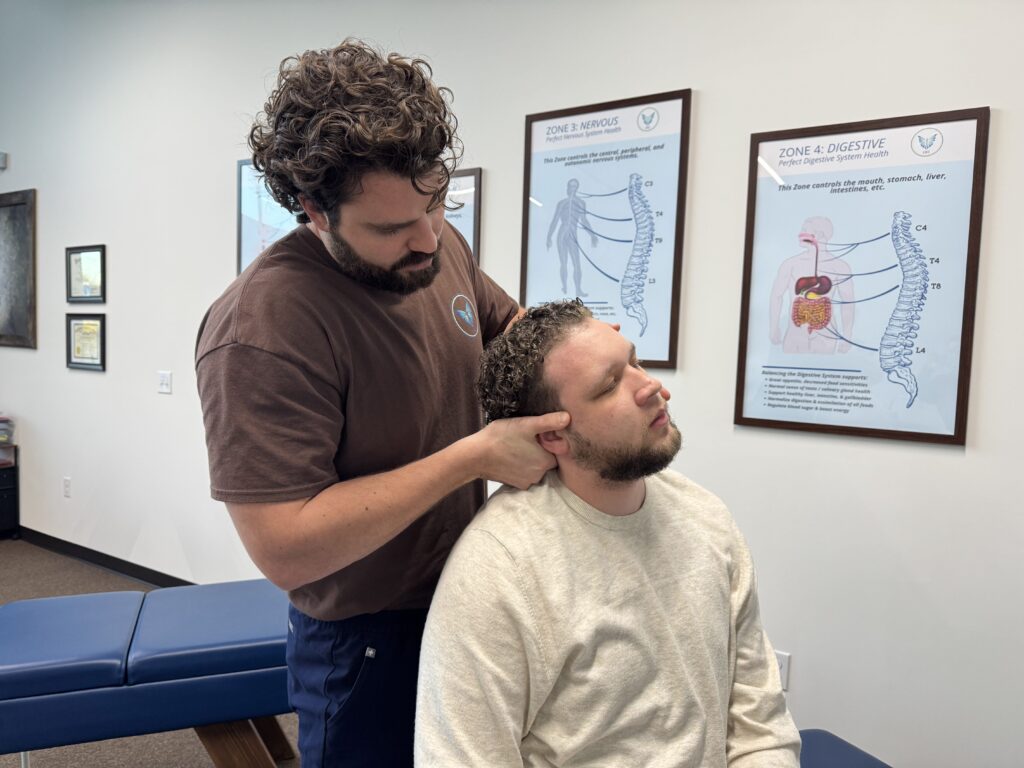
Zone Technique is particularly well-suited to whiplash presentations because the primary driver of persistent whiplash symptoms is nervous system interference, not ongoing tissue damage. The nervous zone(3) governs the cervical nerve roots and the pathways they supply through the shoulders and arms. When Zone 3 is under interference at specific cervical levels following a whiplash injury, the disrupted nerve signals perpetuate the pain pattern and the protective guarding response simultaneously. Addressing Zone 3 interference directly interrupts that cycle at the level of the nervous system rather than just managing the symptom at the tissue level.
The muscular zone(5) tracks the cervical muscle guarding pattern that develops after whiplash and is frequently what sustains symptoms past the acute healing phase. The suboccipital muscles, upper trapezius, and levator scapulae are the structures most commonly locked in protective contraction following a cervical acceleration-deceleration injury. Zone 5 interference maintains that contraction pattern even when the structural reason for it has resolved. The Zone Technique adjustment at the levels driving Zone 5 interference releases the pattern and restores more normal cervical muscle tone.
A systematic review in the journal Pain Research and Management found consistent evidence supporting mobilization as an effective noninvasive intervention for acute whiplash-associated disorders, which aligns with what Zone Technique delivers at the cervical spine. Dr. Korrin assesses both Zone 3 and Zone 5 at every visit and adjusts at the specific levels where interference is found rather than applying a standardized cervical protocol to every whiplash presentation.
What to Expect at Your First Visit
Your first visit begins with a Zone Technique assessment of the full nervous system. Dr. Korrin evaluates all six zones and identifies where interference is present, then focuses on the cervical levels most relevant to your whiplash pattern. The assessment takes 15 to 20 minutes. He will ask about the mechanism of the injury, when symptoms appeared relative to the accident, what the pain pattern looks like now, and whether you have any arm, hand, or shoulder symptoms that suggest nerve root involvement.
If you have had imaging done after the accident, bring it. X-ray and MRI results from the acute phase help Dr. Korrin understand the structural picture and rule out anything that falls outside chiropractic scope before care begins. The adjustment for an acute whiplash presentation is gentler and more targeted than care for a chronic cervical pattern. The nervous system is in a heightened state and the adjustment approach reflects that. Most acute whiplash patients start with two to three visits per week for the first two to three weeks, then reassess based on how the cervical interference pattern is responding.
If your whiplash is producing arm radiation, numbness, or tingling, the pinched nerve chiropractic care page covers how Zone Technique addresses cervical nerve root involvement. Post-whiplash headaches that develop in the days following an accident are covered on the headaches chiropractic care page. For the broader cervical pain picture that whiplash is part of, the neck pain chiropractic care page covers how Dr. Korrin approaches cervical presentations across all causes.
Most whiplash patients who find Vita Nova in Plano, TX come in after the standard post-accident pathway has not resolved their symptoms. They saw their primary care physician in the days after the accident, were prescribed muscle relaxants or anti-inflammatories, were told to rest, and found that two to four weeks later the neck pain and headaches had not fully resolved. Patients from Murphy and Richardson also make up a meaningful part of whiplash presentations at the practice, often referred by other patients who found Zone Technique effective for their own cervical injuries.
Dr. Korrin is accepting new patients at Vita Nova in Plano, TX. Schedule your first visit to find out whether the nervous system interference pattern your whiplash created is something Zone Technique can address.