
The knee is painful but the knee may not be the problem. Knee pain that changes with lumbar position, that is accompanied by thigh or calf symptoms, or that did not follow a clear mechanism of injury at the knee itself often has a lumbar nerve root component that the knee-focused evaluation misses. Zone Technique identifies whether the pain is originating in the knee joint and surrounding structures, in the lumbar nerve root supply, or in the hip and pelvic mechanics that alter how load is distributed through the knee during movement.
What Could Be Causing Your Knee Pain?
Knee pain in adults has several distinct origins. True knee joint pathology, including meniscal tears, osteoarthritis, patellofemoral syndrome, and ligament injury, originates in the knee itself and is confirmed on imaging or clinical examination. Referred knee pain from the lumbar spine, specifically the L3 and L4 nerve roots, produces anterior knee and lower thigh pain that is frequently mistaken for patellofemoral or quadriceps tendon pathology. The L5 nerve root produces lateral knee and calf symptoms. Hip pathology and gluteal weakness alter the mechanics of the knee during weight-bearing activities, increasing the valgus stress on the medial compartment and producing medial knee pain that responds to hip assessment rather than knee treatment.
Knee pain that recurs despite appropriate local treatment, that is worse after sitting for long periods in a way that a purely mechanical knee problem would not explain, or that is accompanied by any sensation in the thigh or calf is worth assessing from the lumbar spine before assuming the problem is in the knee.
How Dr. Korrin Approaches Knee Pain Using Zone Technique
For knee pain, Zone Technique assesses the nervous zone(3) at the L3 through L5 lumbar levels governing the nerve supply to the knee and lower leg. When Zone 3 shows interference at those levels, the nerve roots supplying the knee are sensitized at their origin, which amplifies any local pain signal at the knee and slows recovery from local pathology. The muscular zone(5) tracks the quadriceps, hamstring, and gluteal activation patterns that govern knee mechanics. When Zone 5 is under interference at the lumbar and sacral levels governing those muscles, compensatory movement patterns develop that increase knee joint load and maintain the pain cycle independent of what is happening at the knee itself. Dr. Korrin adjusts at the specific levels where interference is found at every visit.
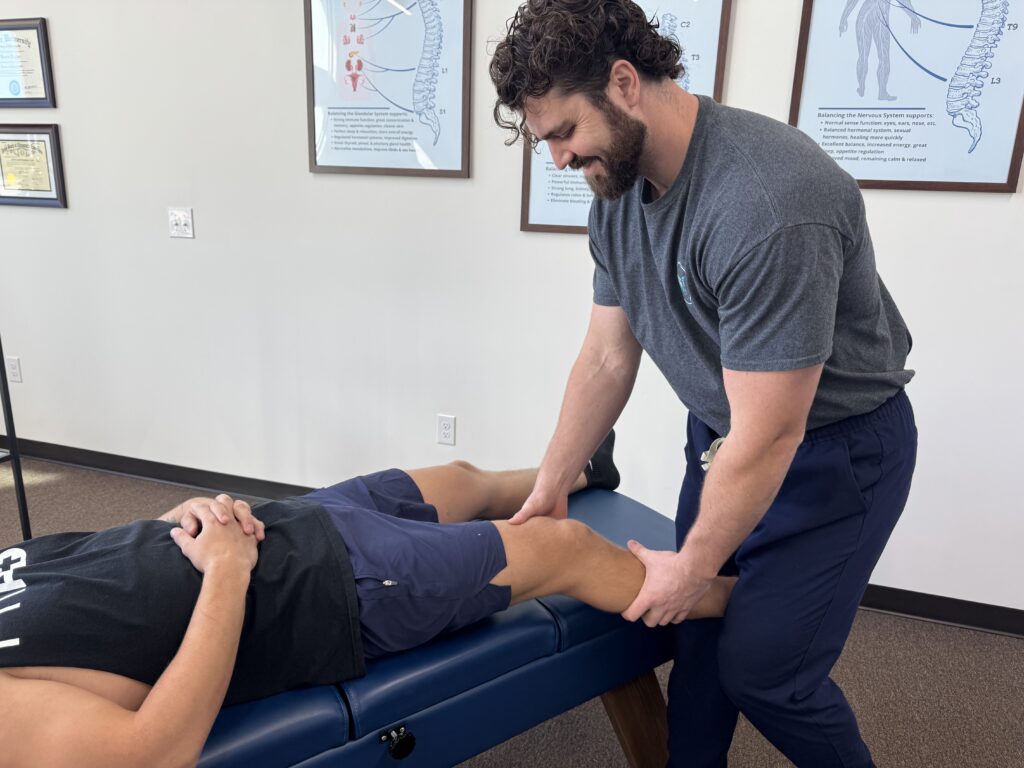
Your first visit begins with a Zone Technique assessment of the full nervous system. Dr. Korrin evaluates all six zones and identifies where interference is present, with particular focus on the lumbar levels most relevant to the knee pain presentation. The assessment takes 15 to 20 minutes. He will ask about the pain location on the knee, whether it is anterior, medial, or lateral, what provokes it, whether any mechanism of injury is involved, and whether there are any symptoms in the thigh or calf alongside the knee pain. Bring any imaging from prior knee evaluation if available. For knee pain with an associated hip or lower back component, the SI joint and hip mechanics picture is worth evaluating alongside the knee presentation. For knee pain in an athlete or runner, the sports chiropractic assessment covers the full lower extremity movement pattern. Dr. Korrin is accepting new patients at Vita Nova in Plano, TX. Schedule your first visit to find out where your knee pain is actually coming from.