Halfway through the grocery store, your legs start to feel heavy. Your lower back tightens. You lean forward on the cart because standing upright makes everything worse. Then, once you sit down, the pressure eases enough that you wonder what just happened.
That pattern is one of the most recognizable signs of spinal stenosis. The narrowing in the spine isn’t constant — it’s positional. And because nerves are involved, the symptoms don’t always stay where the problem is.
What Is Spinal Stenosis?
Spinal stenosis means part of the spine has become narrowed. That narrowing reduces space around the spinal cord or the nerve roots that exit the spine. When those nerves have less room, they become irritated or compressed during certain movements — particularly standing upright or walking for extended periods.
Stenosis develops over time. Disc degeneration, arthritis, thickened ligaments, bone spurs, and old injuries all contribute. It most commonly affects the lumbar spine, where the symptoms show up in the low back, hips, legs, and feet. When it affects the cervical spine, symptoms travel into the neck, arms, and hands instead.
Spinal stenosis frequently overlaps with
sciatica,
degenerative disc disease, and chronic back pain. Dr. Korrin evaluates the full pattern rather than treating each label as a separate problem.
Common Symptoms of Spinal Stenosis
Spinal stenosis doesn’t always feel like simple back pain. Because nerves are involved, symptoms may travel away from the spine and affect walking, balance, strength, and sensation:
- Low back pain or stiffness
- Pain into the hip, buttock, or leg
- Numbness or tingling in the legs or feet
- Heavy, tired, or weak legs while walking
- Symptoms that improve when sitting or bending forward
- Difficulty standing for long periods
- Balance changes or reduced walking confidence
- Neck, arm, or hand symptoms when stenosis affects the cervical spine
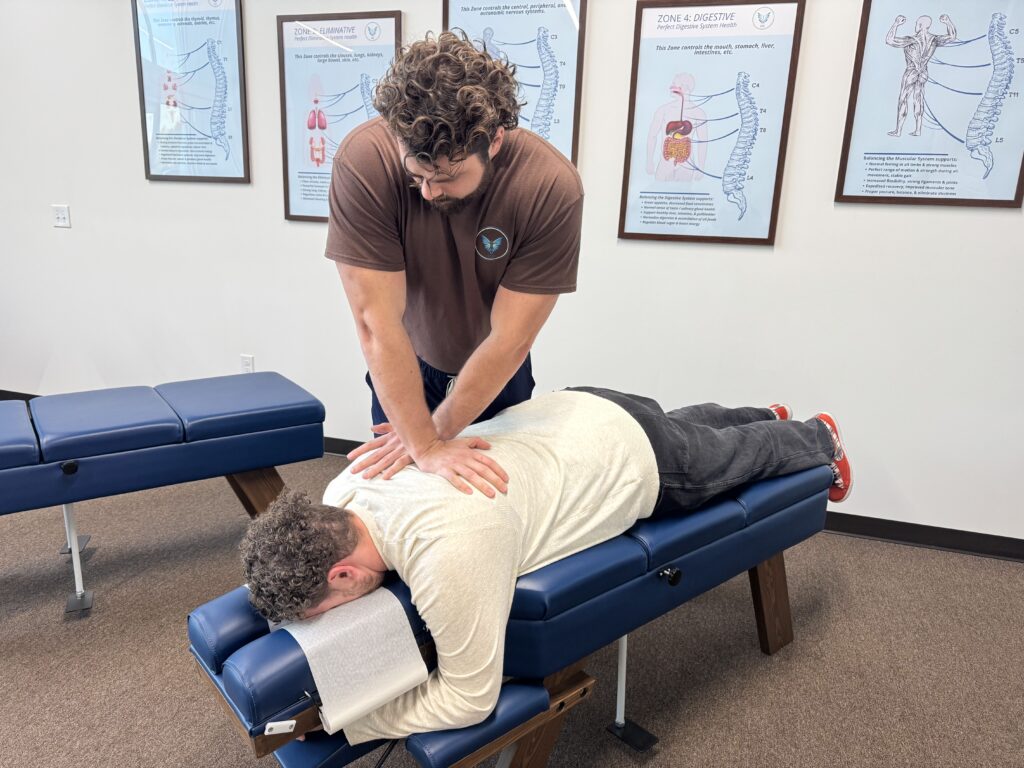
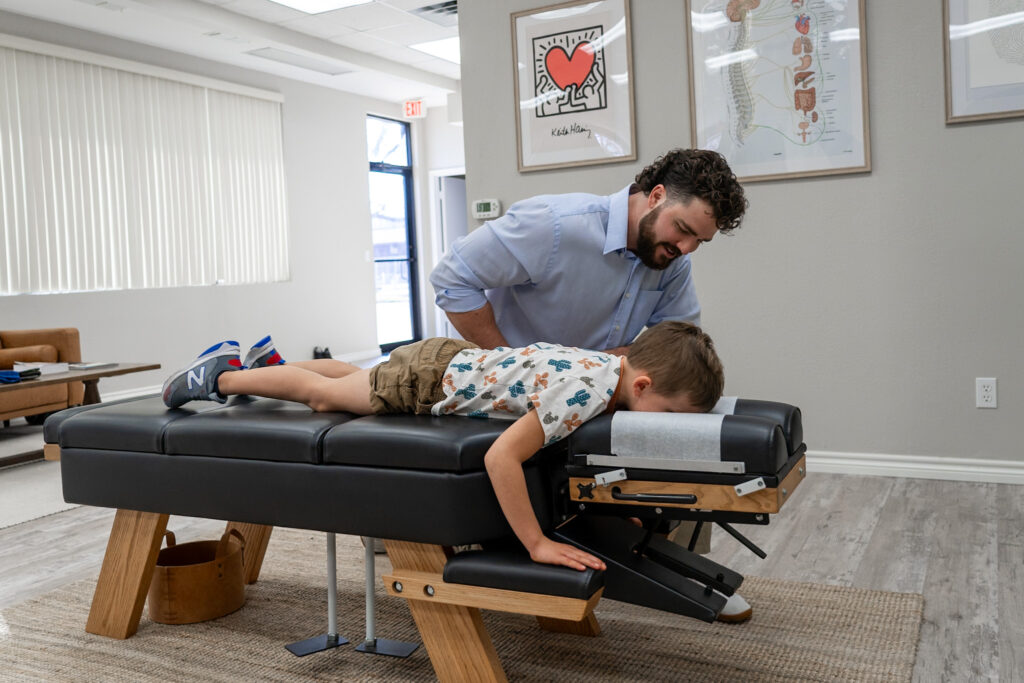
How Dr. Korrin Treats Spinal Stenosis Using Zone Technique
Chiropractic care doesn’t open the spinal canal or reverse structural narrowing. Honest expectations matter here. The goal is to improve how the spine, pelvis, muscles, and nervous system are functioning around that narrowed area — reducing the mechanical stress on nerves that are already sensitive.
When spinal joints lose motion, nearby muscles guard. Posture changes. Walking mechanics shift. Those adaptations add load to nerves that have less room than they used to.
Zone Technique gives Dr. Korrin a structured way to evaluate how those adaptations are affecting the entire nervous system, not just the painful segment.
For spinal stenosis patients three zones are consistently involved.
Zone 3, the nervous zone, is the primary focus. Spinal stenosis irritates the nerve roots governing pain, sensation, strength, and coordination. Zone Technique maps nervous system function at each spinal level and identifies where interference is disrupting brain-body communication. Adjustments target those specific levels, not the symptom location.
Zone 5, the muscular zone, addresses the guarding pattern that forms around a stenotic segment. Paraspinal muscles tighten chronically around irritated nerve roots, changing posture and compressing the already-narrowed canal further. Addressing Zone 5 alongside Zone 3 changes what the spine is carrying between visits.
Zone 6, the circulatory zone, supports blood flow and recovery to irritated tissues. Nerve roots under chronic compression need adequate circulation to maintain function. Zone Technique assessment identifies where circulatory interference is present and addresses it directly.
Research published in the
Journal of the American Academy of Orthopaedic Surgeons supports individualized conservative care for lumbar spinal stenosis before considering surgical options, noting that symptom severity, function, and patient-specific factors should guide treatment decisions. Dr. Korrin’s Zone Technique assessment is built around exactly that kind of individualized evaluation.
If lower back stiffness, nerve irritation, and movement limitations are part of the same picture, the
back pain chiropractic care page covers how Zone Technique approaches that broader pattern.
What to Expect at Your First Visit
Your first visit starts with a detailed conversation. Dr. Korrin asks where symptoms travel, what makes them worse, and what gives relief. Details like “walking makes it worse” or “sitting helps” are important because they give specific clues about which nerve roots are involved and how the stenosis is behaving.
The assessment takes 15 to 20 minutes and includes postural evaluation, spinal motion testing, and a full Zone Technique evaluation across all six zones. If your symptoms suggest chiropractic care isn’t the right starting point, Dr. Korrin will tell you directly.
Seek medical attention immediately — not a chiropractic visit — if you experience sudden leg weakness, loss of bowel or bladder control, numbness in the groin or saddle area, fever with severe back pain, or symptoms following a major fall or accident. These require emergency evaluation.
Dr. Korrin sees spinal stenosis patients across a wide range of presentations at Vita Nova in
Plano, TX. Desk workers whose stenosis built gradually from years of sustained lumbar loading. Adults who’ve been managing symptoms for years and are looking for a conservative approach before considering surgery. Older adults whose walking distance has been shrinking without a clear explanation. All three presentations respond to Zone Technique care differently depending on which zones are most active.
Have questions about how spinal stenosis and sciatica overlap? The
sciatica FAQ page covers the nerve compression questions patients ask most.
Dr. Korrin is accepting new patients at Vita Nova Chiropractic in Plano, TX. If spinal stenosis is limiting how you walk, work, or move,
schedule your first visit and get a clear picture of what the nervous system is doing.