


1. Favoring One Side of the Head or Body
If you’ve noticed your baby always turns their head the same direction, or they seem to only want to nurse on one side, that’s usually torticollis, which really just means there’s tightness or restriction on one side of the neck. A lot of the time this comes from how they were positioned in the womb, or from the mechanics of delivery itself, birth is a big deal on a tiny body. This is one of the most common reasons I see a baby in those first few weeks.2. Trouble Settling or Staying Asleep
Every baby wakes up at night, that’s just part of it. But there’s a difference between a baby who wakes up hungry and goes back down, and a baby who can’t seem to fully relax, startles easily, or fights sleep even when you can tell they’re exhausted. When I see that pattern, I’m usually looking at whether there’s some tension somewhere that’s keeping their nervous system from shifting into that calm, rested state the way it should.3. Prolonged or Difficult Crying
Colic, which is generally crying more than three hours a day, more than three days a week, is common, and it usually works itself out by three or four months on its own. I want to be straight with you here though. The research on chiropractic care and colic is mixed. Some studies show a benefit, and some of the more recent, higher quality reviews haven’t found a clear difference compared to doing nothing at all. What I can offer is a careful look at whether there’s a restriction somewhere that’s adding to your baby’s discomfort. I’m not going to promise you a fix, because that wouldn’t be honest.4. Feeding or Latching Difficulty
Trouble getting a good latch, or a clear preference for one side over the other, sometimes has a mechanical piece to it, especially when it shows up alongside that same one-direction head turn I mentioned. This is one I want you talking to your lactation consultant and your pediatrician about too, not just me, because feeding issues can come from a lot of different places and I want the full picture, not just my piece of it.5. Reflux-Like Symptoms
Spit up, arching during or after feeds, general discomfort lying flat, all of that is common in the first several months, and it usually resolves as your baby’s digestive system matures. If it’s not letting up and you’ve already been working with your pediatrician on it, some parents want to know whether there’s a nervous system piece to the digestion side of things worth looking at. Sometimes there is.6. An Uneven Head Shape
Flat spots, plagiocephaly is the technical term, tend to show up right alongside a positional preference or torticollis, because a baby who always turns one way is also going to rest more weight on that same side of the head. In my experience this is something you address together, the underlying preference along with the tummy time and repositioning your pediatrician’s already recommending. It’s rarely just one thing fixing it.7. General Tension or Discomfort With No Clear Cause
Sometimes there isn’t one specific symptom. It’s more that your baby just seems uncomfortable in their own body, stiff when you hold them a certain way, unsettled and you can’t quite put your finger on why. Honestly, this is one of the more common things I hear from parents at that first visit, and it’s exactly what a hands-on assessment is built to sort out.What the Research Actually Says
A 2022 systematic scoping review in BMC Pediatrics looked broadly at spinal manipulation and mobilization in infants, children, and adolescents. What they found is that while it’s widely used, the overall quality of research behind specific outcomes is still limited, and the authors are calling for more rigorous studies across most of these pediatric applications. Separately, a 2020 rapid review in Chiropractic & Manual Therapies looked specifically at safety in children under 10, and found that mild adverse events do happen, at rates that vary a lot across the studies they reviewed, while the risk of anything moderate or severe is genuinely unknown because there just isn’t enough high-quality data yet, especially with the gentle, low-force approach I use for infants versus the higher-force techniques studied in some adult contexts. I’d rather tell you that honestly than promise you something the research hasn’t actually settled.
What an Assessment Actually Looks Like
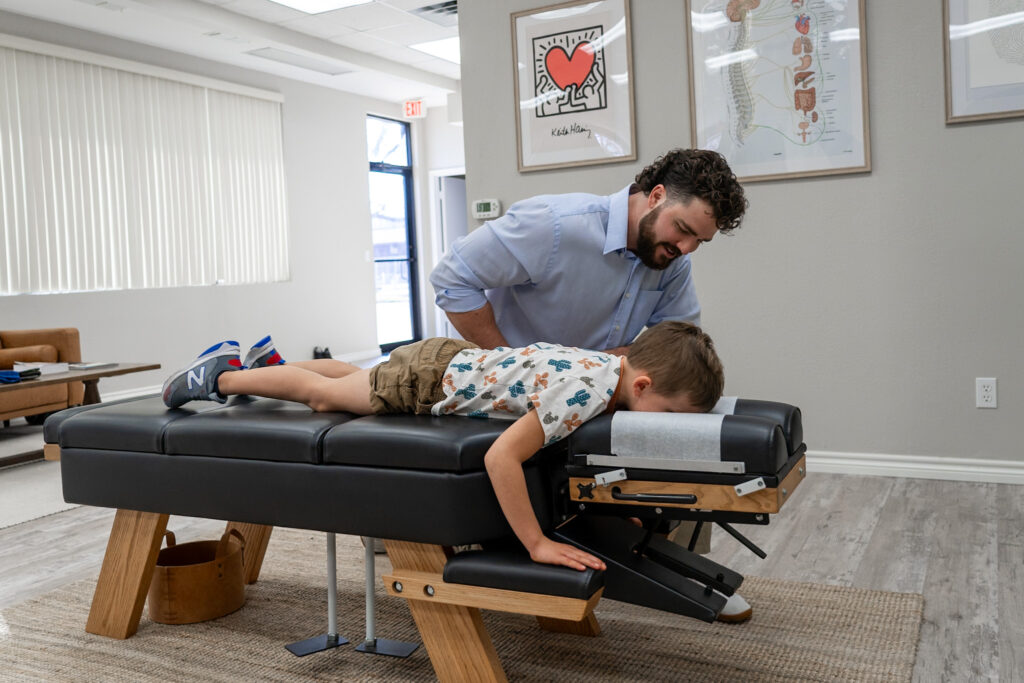
When I see an infant for the first time, I start with a hands-on Zone Technique assessment, not an assumption about what’s wrong. I’m checking how your baby’s spine and nervous system are actually functioning, looking specifically at whether there’s restriction and exactly where it is. If I don’t find anything, I’ll tell you that directly, no reason to manufacture a problem that isn’t there. If I do find something, the amount of pressure I use is nowhere near what people picture when they hear the word chiropractor. Adjusting an infant takes about the same amount of pressure you’d use pressing on your own closed eyelid and still being completely comfortable. That’s it. I hold it until I feel the joint release, and that’s the whole adjustment.
If your pediatrician has ruled out anything that needs medical attention and you’re still looking for answers, I’m happy to take a look and give you an honest read on what I find. This kind of careful, gentle assessment is really the foundation of everything I do in pediatric chiropractic care. Schedule a visit and let’s find out what’s going on.