

I know because I had it. When I started playing basketball again for the first time since college, I switched to minimalist shoes at the same time, and I was about 50 pounds heavier than my college self. Six months later, the first steps out of bed felt like stepping on a knife in my heel. The routine below is exactly what I used to get back on the court, and it’s what I walk patients through at our Plano office.
Why Stretching Alone Doesn’t Fix It
Stretching alone rarely fixes plantar fasciitis because the real problem is usually capacity, not tightness. Tightness plays a role, but it isn’t the root cause. You’ll also hear this called plantar fasciopathy, and that name is more accurate. Despite the “itis,” a review in American Family Physician describes it as a degenerative problem rather than an inflammatory one.
Here’s how I explain it to patients: it’s a capacity problem. The fascia has been asked to handle more load than it can bear, and over time the tissue starts to break down. More demand on the foot plus more force going through it than the tissue is ready for equals pain. That was my story exactly, and I see the same pattern in Plano patients who suddenly add miles on the Oak Point Park trails or start a job where they’re on their feet all day. Stretching can ease the tightness, but it doesn’t rebuild the capacity, which is why stretching alone rarely finishes the job.
Heel or Arch? Where It Hurts Matters
Plantar fasciitis usually hurts at the front of the heel on the bottom of your foot, right where the fascia anchors into the heel bone, and it’s worst with your first steps in the morning and after sitting. About 1 in 10 people will have it at some point, per that same AFP review. If that’s you, this is almost certainly plantar fasciitis.
Some people feel it more in the middle of the arch. That can still be the fascia, but the arch is also where the small muscles of the foot live, so I think a little more broadly there. The good news is that this routine helps both, because it’s built on the same two things: loosening the calf and ankle, and rebuilding the strength of the foot.
Before Your First Steps: The Plantar Fascia Stretch
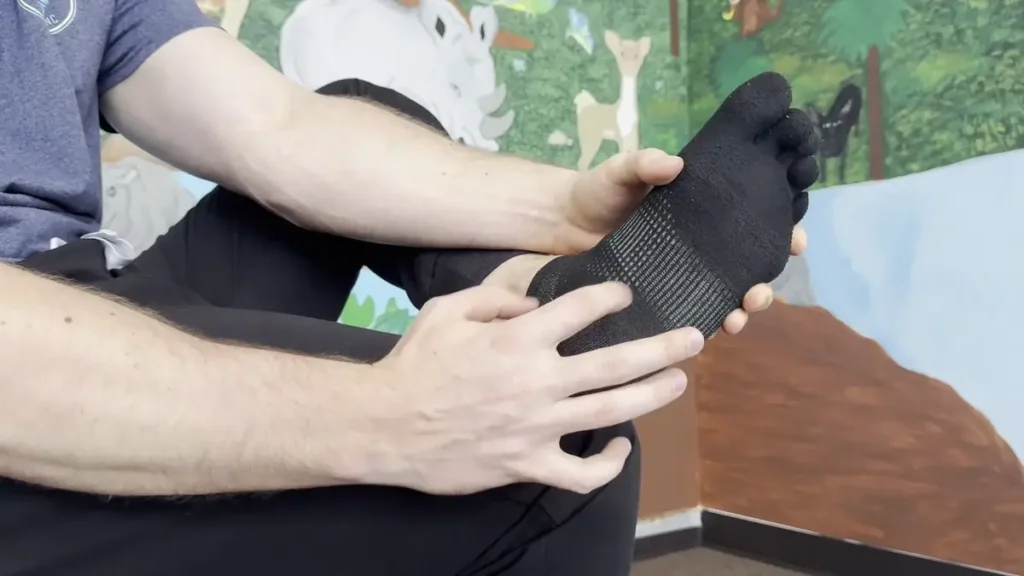
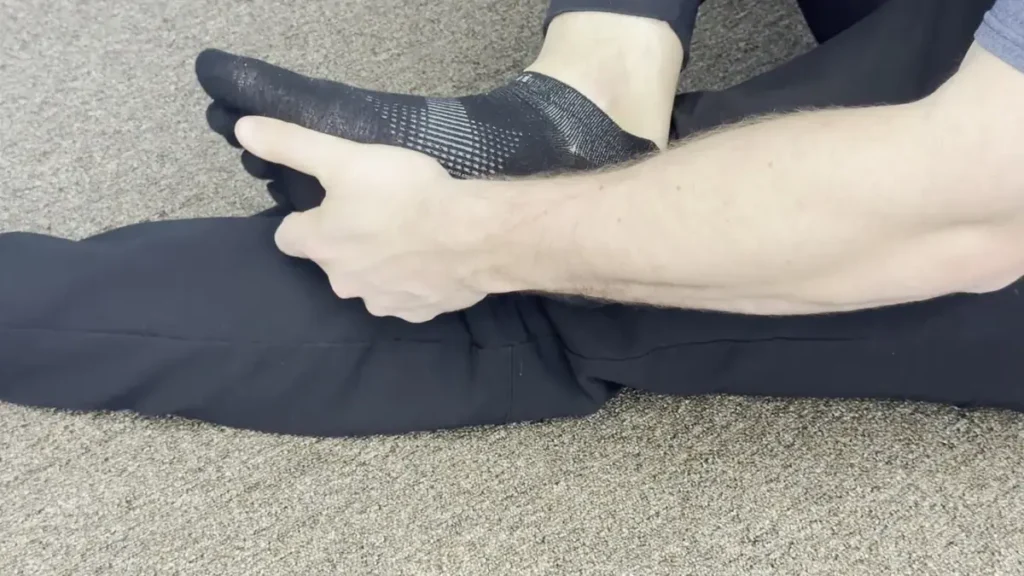
The seated plantar fascia stretch is the best-studied stretch for morning heel pain, so do it before your feet ever hit the floor. Sit on the edge of the bed, cross the sore foot over the other knee, and pull your toes back toward your shin until you feel the band under your arch go tight. You can feel it with your thumb. Hold 10 seconds, 10 times, before you stand up. A randomized trial in the Journal of Bone and Joint Surgery found this stretch beat the standard calf stretch for first-step morning pain in people who’d had heel pain for 10 months or more. The timing is the point: you’re warming the fascia up before it has to take your weight.
Stretch 1: The Calf, at Two Angles
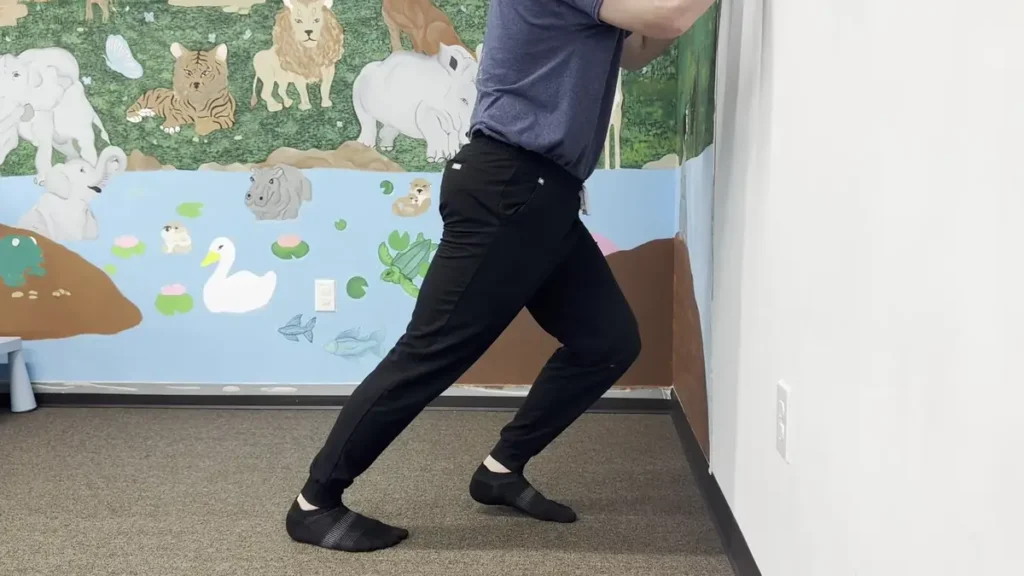
Stretch your calf at two angles, knee straight and knee bent, because two different muscles pull on the Achilles tendon and heel. Stand facing a wall with the sore leg back. Do it once with the back knee straight, for the big calf muscle (the gastrocnemius), and once with the knee bent, for the deeper soleus underneath. Hold 30 to 45 seconds, twice on each leg, for each angle.
Two things make or break it. Keep the back heel flat, because the second it lifts, the stretch is gone. And keep the back foot pointed straight ahead, not turned out. With the knee straight you’ll feel it high in the meaty part of the calf. Bend the knee and it should drop lower, just above the heel.
Stretch 2: Knee to Wall
Knee to wall loosens a stiff ankle, which is the strongest risk factor for plantar fasciitis the research has found. Face the wall with your foot a few inches back and drive your knee forward over your toes, trying to touch the wall without your heel lifting. Do 8 to 10 reps, twice, starting with the side that hurts more. The knee should track over the middle of your foot, not cave inward. If your heel pops up, scoot closer and shorten the range.
That’s why this one matters more than people think. A case-control study found that people with the stiffest ankles were more than 20 times as likely to have plantar fasciitis as people with normal ankle motion. A stiff ankle forces the foot to take more load on every step.
The Part Most People Skip: Heel Raises With a Towel
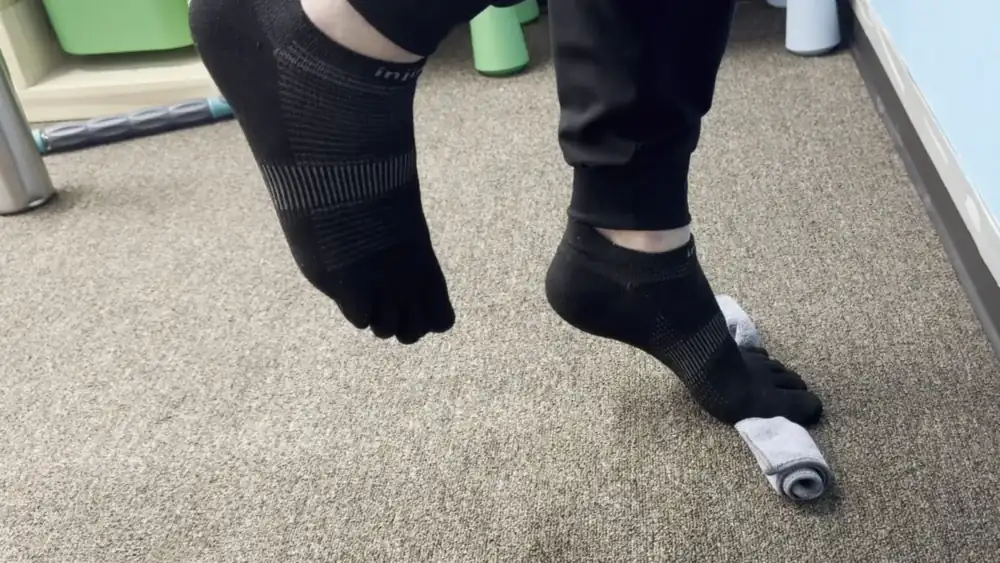
A slow single-leg heel raise with a towel under your toes is the most important exercise for plantar fasciitis. Stand on the sore foot with a towel rolled up under your toes, holding a wall or chair for balance. The towel puts the fascia on tension while you load the calf, and that’s exactly what rebuilds its capacity. A Danish trial found that this kind of slow, heavy heel raise got people better faster than stretching alone.
Tempo matters: 3 seconds up, a 2-second hold at the top, 3 seconds down. Rise straight up over your big toe and second toe, and don’t let your ankle roll out toward the pinky side, which is the most common mistake. Control the way down as much as the way up. That slow lowering is where a lot of the benefit is.
Do them three days a week, like Sunday, Tuesday and Thursday, never back to back, because the tissue needs the day off to adapt. Then keep adding load:
- Weeks 1 to 2: 3 sets of 12, body weight
- Weeks 3 to 4: 4 sets of 10, start adding weight
- Week 5 and on: 5 sets of 8 with a backpack or dumbbell, and keep adding as it gets easier
That progression is the difference between managing heel pain forever and getting rid of it.
Wake Up the Foot
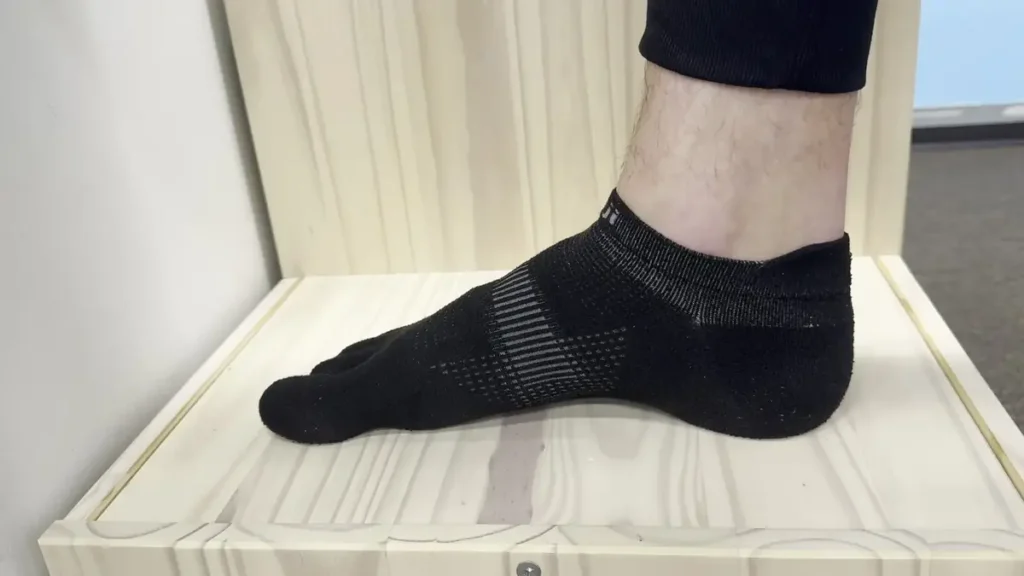
Four small exercises rebuild the muscles that hold up your arch: short foot, the big toe press, resisted eversion and single-leg balance.
- Short foot (doming): Sitting, foot flat, pull the ball of your foot toward your heel without curling your toes. The arch lifts slightly and the toes stay long and flat. Hold 5 seconds, 10 times. If your toes curl or your foot cramps, go smaller. Most people don’t feel it the first week. That muscle has been asleep, and it takes a few tries to wake it up.
- Big toe press: Spread your big toe away from the others (it’s fine to move it with your hand at first), lift the other four toes, and press just the big toe into the floor. Hold 5 seconds, 10 times. Almost nobody does this cleanly on day one, and the effort still trains the muscle.
- Resisted eversion: Loop a band around the outside of your foot and turn the sole outward against it, 3 sets of 15. Move only from the ankle, slow in both directions. No band? Press the outside edge of your foot into a wall and hold for 5 seconds.
- Single-leg balance, barefoot: 30 to 45 seconds, 3 times per leg. Once that’s easy, close your eyes. You’ll feel the arch and ankle making constant small adjustments, which is the point.
On Flare-Up Days
On a flare-up day, swap the heel raises for a hold at the top of the raise. If your first-step pain is 2 or more points worse on a given day, skip the full reps and just hold: 30 to 45 seconds, 4 to 5 times. That calms the pain down while still loading the tissue, so you keep making progress without aggravating it.
If Your Pain Is in the Arch
If your pain is in the arch, lean harder on the short foot and big toe press, since the arch is where those small muscles live. Go easy on rolling the arch, because you’ll be rolling right on the sore spot, so keep it very light or skip it. If a specific spot gets sharp during heel raises, shorten the range or switch to the holds.
When to Get It Checked
Get it checked if your mornings aren’t improving after about six weeks of consistent work, or if the pain tingles, burns, sits on the back of the heel instead of underneath, or hurts as much at rest as on your feet. Those can point to a nerve problem or a stress fracture rather than plantar fasciitis. Mid-arch pain is the case I most want to see in person, because there are a few more things it can be.
In the office I measure your ankle, watch how you walk, and check the low back and hips, since they change how the foot lands. Then I use Zone Technique to work on the stiff ankle and calf that are overloading the heel. The plantar fasciitis care page walks through what that visit looks like, and the free stretch library has guided ankle and calf videos you can follow at home.
Stretching gives you relief, but strengthening is what gets rid of it.
If your heel still hurts after a few weeks of this, I’m glad to take a look at our Plano office on East Plano Parkway, a few minutes from Bob Woodruff Park. Schedule a visit.